

NEW YORK CITY, NY / Globe PR Wire / March 2, 2026 / Throughout the long history of global finance, monetary systems have undergone multiple structural transformations—from the gold standard to fiat currency, and from paper money to electronic and digital forms of money. Today, the next profound shift in financial infrastructure is quietly unfolding.
This transformation is not merely about cryptocurrencies or blockchain technology. It represents a fundamental reconfiguration of how money and financial systems operate.
Coinbase is actively driving this transformation. Through its strategic positioning in stablecoins, Base, enterprise payments, and treasury systems, it is not simply expanding crypto adoption—it is laying the groundwork for the next evolution of the global monetary system. What it is building is a new form of on-chain banking: a structural migration of deep significance, representing the next-generation architecture of global monetary settlement.

The Evolution of the Global Monetary System: From Gold Standard to Digital Currency
Over the past centuries, the global monetary system has broadly progressed through several stages:
1.The Gold Standard Era
Currency value was backed by gold reserves. Circulation depended on the quantity of physical gold held by nations. Monetary credibility was rooted in tangible assets.
2.The Rise of Fiat Currency
In the 20th century, the gold standard was gradually abandoned. Fiat money emerged, backed not by gold but by sovereign credit and economic strength.
3.The Era of Electronic Money and Digital Payments
With technological advancement, electronic payments and digital financial systems became the global norm. Banks continued to manage accounts and settlement, but transactions shifted from physical cash to digital transfers.
4.The Rise of Decentralized Finance and Blockchain
Blockchain and cryptocurrencies broke the physical constraints of traditional money. Stablecoins—crypto assets backed by fiat—began challenging traditional monetary systems with greater transparency, cross-border efficiency, and lower costs.
Coinbase: From Exchange to Financial Infrastructure Builder
In its 2026 Q4 shareholder letter, Coinbase clearly articulated its transformation from a cryptocurrency trading platform into a builder of global financial infrastructure. It is no longer merely an exchange—it is reconstructing global payment and settlement networks.
The letter emphasized three core pillars:
- The evolving role of stablecoins
USDC is shifting from a trading medium to a core asset for enterprise settlement and treasury management. It is emerging as a global payment standard, with enterprises increasingly adopting stablecoins as default settlement instruments.
- Base as a settlement layer
Base is more than a Layer 2 network—it is Coinbase’s foundational on-chain settlement infrastructure. It represents a new architecture for clearing systems, breaking free from the constraints of traditional banking rails.
- Enterprise payments and treasury management
Coinbase provides blockchain-based payment interfaces and treasury systems, enabling enterprises to settle and manage capital directly on-chain—more efficiently, transparently, and at lower cost.
These initiatives do not merely support the crypto ecosystem—they pave the way for the evolution of the global monetary system itself.
On-Chain Settlement: A Disruptive Shift in Global Payments
Traditional global payment systems rely on interbank clearing networks such as SWIFT and ACH. These systems are constrained by geography, time zones, intermediaries, and cost structures. Cross-border payments can take days to settle, involve multiple intermediaries, and incur significant fees.
More importantly, the clearing layer of traditional finance is deeply embedded within sovereign banking structures. The global payment framework has long been controlled by centralized institutions.
Coinbase is building a decentralized settlement layer. Through Base and USDC, it enables real-time global settlement with minimal fees. This network eliminates the temporal inefficiencies and cost burdens of traditional systems.
In Coinbase’s vision, settlement no longer depends on bank networks. The combination of Base and USDC liberates global payments from intermediary banks, national borders, and legacy infrastructure.
As Base matures, it could function as a default global clearing layer—analogous to SWIFT—but decentralized, blockchain-based, and frictionless.
Stablecoins: Infrastructure for Decentralized Finance
Stablecoins are more than digital tokens. They are a new form of money—pegged to fiat currencies to eliminate volatility, making them suitable for everyday transactions and financial operations.
Coinbase is positioning USDC as a core enterprise payment asset. The proliferation of stablecoins represents the digitization and decentralization of fiat currency within blockchain systems.
Enterprises and individuals can store, manage, and transfer funds directly on-chain—without relying exclusively on traditional banking platforms.
The adoption of stablecoins signals a decentralization and restructuring of the global monetary framework, creating new models for cross-border payments, treasury management, and asset organization.
The Next Phase of the Global Monetary System
By advancing stablecoins, Base, and enterprise financial systems, Coinbase is accelerating the transition into a new monetary era.
In this era:
- Settlement is no longer monopolized by banks.
- Payments and treasury management transcend national borders.
- Financial capability becomes protocol-based rather than institution-based.
As on-chain settlement and decentralized finance expand, we are witnessing the structural decentralization of the global monetary system.
Infrastructure providers like Coinbase will anchor this transition. On-chain banking initiatives such as B18 represent early prototypes of this emerging financial architecture.
The clearing layer of the global monetary system is migrating. Future banks may no longer resemble traditional banks—they will become protocol-based financial service platforms.
The future has already begun.
B18: Becoming a Pilot Model of On-Chain Banking
As Coinbase advances on-chain financial infrastructure, we are observing a structural migration—not an expansion of trading markets or incremental payment optimization, but a reconstruction of the settlement layer itself.
Coinbase’s recent public letter makes the direction explicit:
- Stablecoins are becoming enterprise settlement assets.
- Base is evolving into an on-chain clearing network.
- Payment and treasury capabilities are being API-ized.
When clearing authority migrates from banking networks to on-chain ledgers, the organizational structure of banks must change.
In this context, B18 is not a peripheral product. It is a structural sample—a prototype exploring how banking should be reorganized when settlement occurs on-chain.
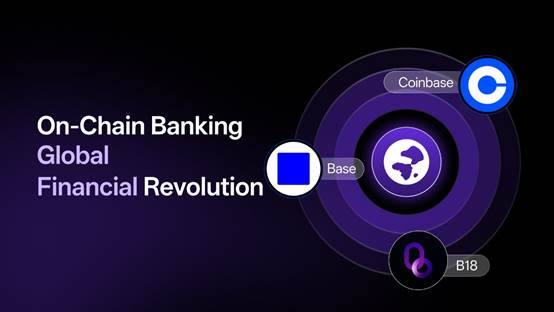
B18’s Positioning: A Structural Pilot Model of On-Chain Banking
Traditional banks revolve around three core functions:
- Account organization
- Interest accrual
- Settlement control
Historically, these relied on physical branches, centralized ledgers, and internal systems. B18 reconstructs these behaviors on-chain.
Operating on the Base settlement network and built upon the B4626 protocol standard layer, B18 decomposes banking semantics into composable interfaces:
- Time Bank account structures
- Cyclical asset stratification (Cycle / Tranche)
- Automated interest accrual
- Settlement-driven engines
- Payment loop modules
It is neither a single vault product nor merely a payment tool—it is an on-chain implementation of a banking organizational model.
The Three Core Capabilities of On-Chain Banking
1. Protocolized Account Structure
In traditional systems, accounts exist within internal bank ledgers.
In B18, an account becomes a time-structured asset container. Funds entering a Time Bank acquire lifecycle attributes—cycle parameters, interest logic, and settlement rules.
Accounts become programmable structures rather than static balances. Capital organization becomes protocol-defined.
2. Standardized Interest and Cycles
Bank value derives not from balances, but from time-based capital organization.
B4626 abstracts interest accrual and cycle logic into standardized interfaces:
- Interest logic is verifiable
- Cycle rules are composable
- Asset stratification is transparent
Interest shifts from internal bank calculation to on-chain rule execution. Contractual periods become protocol parameters.
3. Automated and Instant Settlement
Base provides the on-chain clearing rail.
B18 organizes settlement logic above it:
- Automatic settlement at cycle maturity
- Automated interest aggregation
- Automated payment execution
Settlement no longer depends on interbank networks—it executes directly on-chain.
Why This Is a “Pilot Banking Form”
Most DeFi protocols optimize yield distribution.
B18 addresses banking behavior.
It tests a new organizational structure:
- How accounts are structured
- How capital is time-layered
- How interest is standardized
- How settlement is automated
This experimentation carries strategic significance. When settlement fully migrates on-chain, the durable moat will not be payment tools, but systems capable of organizing banking structures at scale.
B18 operates at this structural nexus.
Capital Perspective: The Value of the Organizational Layer
In an on-chain financial system, value migrates from application layers to organizational layers.
If Base is the settlement infrastructure layer, and B4626 the banking semantic protocol layer, then B18 is the first sample application layer organizing them into a full banking structure.
Its long-term value lies not in isolated functionality, but in:
- Accumulated account scale
- Structured cyclical assets
- Settlement frequency compounding
- Closed-loop payment networks
As these components generate network effects, switching costs rise.
This is structural capital—not merely product functionality.
The Mission and Future of B18
B18 does not aim to replicate traditional banks.
It seeks to reconstruct banking logic for the on-chain settlement era.
In this process:
- Accounts become protocol structures
- Interest becomes rule interfaces
- Settlement becomes automated execution
Finance shifts from institution-based to system-based.
When clearing authority migrates, banking inevitably becomes protocolized.
B18 represents one of the earliest structural prototypes of this transformation.
The era of on-chain banking is not rhetoric—it is the outcome of structural migration.
And once structures form, they are difficult to reverse.